Advertising Is Eating the Economy. AI Could Push It Into Excess.
For decades, advertising investment largely moved with the economy. When GDP grew, ad spending followed. When the economy contracted, marketers usually cut faster and deeper.
Around 2015, that relationship changed.
From 2015 to 2025, U.S. media spending rose from roughly $182 billion to $429 billion—far outpacing nominal GDP, according to EMARKETER estimates. Digital advertising grew faster still, from about $60 billion to $351 billion.
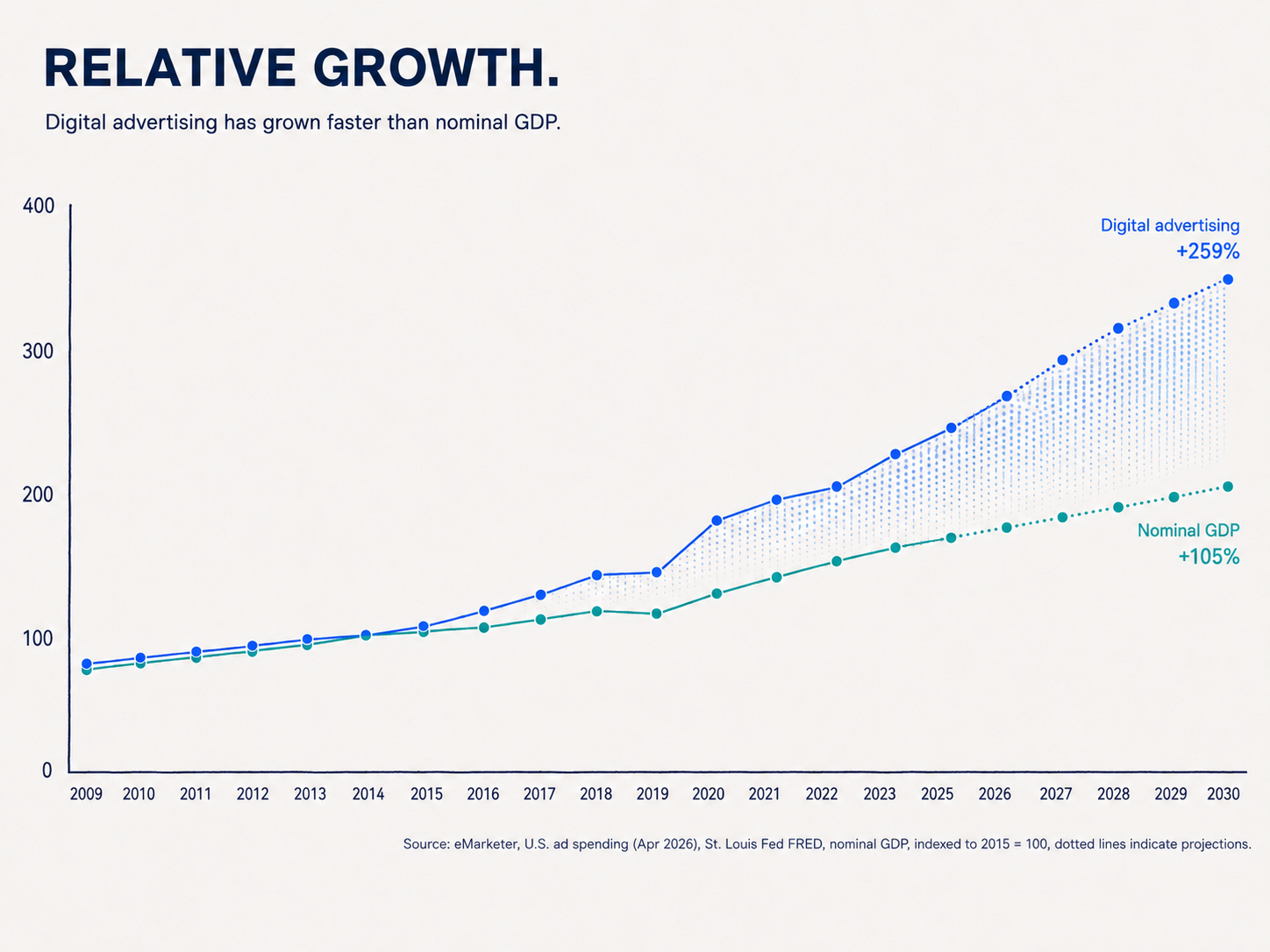
The same shift is visible globally. WPP Media estimates that advertising has reached its highest recorded share of nominal GDP, surpassing the dot-com peak. Ad spend once treated as discretionary is becoming an essential part of how businesses compete.
The easy explanation is that marketers have become more willing to spend. The real story is that our definition of advertising is expanding.
Digital made advertising more measurable, more accessible and more central to commerce. It opened media to new buyers, tied spending more closely to performance, expanded advertising into jobs once handled by sales and merchandising, and gave more companies an advertising revenue model. COVID accelerated all of it, pushing media, commerce and customer acquisition even closer together.
Now AI is poised to take that expansion much further. It will make content cheaper to produce, give more businesses something to monetize and create an enormous new supply of advertising inventory.
But human attention can’t grow with it, and that is the tension at the center of the next advertising boom: more money, more inventory and more claims of performance without an equally mature way to judge the quality of the attention being sold.
The industry still has time to solve that problem before AI abundance becomes advertising excess.
What changed, and why it matters now
There was no single trigger in 2015. Digital advertising had simply become large, accessible and connected enough to reshape the overall market.
Four shifts made advertising more fundamental to growth: it took on more commercial jobs, became harder to cut, opened to more advertisers and became a revenue engine for more companies. Together, they moved advertising closer to the heart of how businesses grow.
Advertising took on more commercial jobs
Digital pushed advertising closer to the transaction. Paid search became demand capture. Sponsored products became digital shelf space and trade promotion. CTV combined brand building with measurable acquisition.
Covid accelerated that convergence. Between 2020 and 2021, total U.S. advertising rose about 26%, digital advertising about 38% and nominal GDP about 11%, as ecommerce, streaming and retail media expanded together.
Spending that once lived in sales, trade marketing or merchandising increasingly appeared in advertising budgets. Advertising wasn’t just doing more marketing. It was doing more of the work of selling.
Performance made advertising harder to cut
Digital also tied advertising more closely to leads, customer acquisition and revenue. Cutting advertising could now mean cutting off a growth source.
That made advertising more defensible and persistent, even if the measurement remained imperfect. Platforms became better at connecting spending to outcomes, but not necessarily at proving which outcomes would have happened anyway.
Advertising became harder to cut because it looked more measurable, even when the measurement wasn’t always right.
More companies became advertisers
Digital lowered the cost, complexity and minimum scale required to buy media. Small businesses, DTC brands and app developers gained access to targeting, bidding and measurement capabilities that had once been unavailable.
CTV is a useful example. For many digitally native companies, it did not shift an existing television budget. Flexible buying, more precise audiences and digital-style measurement made television practical for the first time.
The market grew not only because established advertisers spent more, but because more companies became viable advertisers.
More companies became advertising companies
Retailers, streamers, delivery apps and now AI companies discovered advertising could become a major source of revenue and profit.
That expanded the market from both sides: more companies could buy advertising, and more companies had a reason to sell it. Advertising was becoming a bigger part of how more businesses made money.
AI will accelerate all four shifts
AI should make advertising even more fundamental to growth.
It can improve performance by making decisions about audiences, creative, bids and budgets faster and better. It can also give smaller marketers access to capabilities that once required large teams, agencies and custom technology.
Agents could push advertising further into sales, commerce and customer management by coordinating work that today sits across different teams and systems.
And AI will create far more content, products and services looking to make money through advertising.
That is where the opportunity turns into risk. Cheap impressions will become abundant. High-quality attention will not.
The industry is good at counting impressions, clicks and attributed actions. It is much less equipped to judge which environments earn real attention, create incremental value or deserve a premium.
AI will make advertising more effective, accessible and abundant. The challenge is making sure more supply does not get mistaken for more value.
To keep AI abundance from becoming advertising excess, the industry needs to get much better at valuing quality.
What marketers should do
Treat advertising as growth infrastructure
Advertising is too important to growth to manage like a discretionary expense. Marketers should be as rigorous about where they spend as how much they spend, focusing on what actually drives growth rather than simply protecting or cutting budgets.
Measure what actually changed
Platform-reported performance is not enough. The key question is simple: what happened because of this investment that would not have happened otherwise?
Be clear about the job
Advertising now does many different things: build demand, capture it, acquire customers, win placement. Those jobs should not all be measured the same way. Start by being clear about what each dollar is meant to do.
Put quality on the plan
Cheap impressions will become abundant. High-quality attention will not. Marketers should reward environments that earn real attention and resist confusing more inventory with more opportunity.
The next phase
EMARKETER projects total U.S. media spending to rise from about $485 billion in 2026 to $655 billion in 2030, with digital accounting for nearly all of the increase. If that forecast proves right, advertising will continue gaining prominence relative to the economy.
In an AI age, that prominence will demand more discipline, not more exuberance. Marketers will need to be clearer about what each investment is meant to do, more rigorous about what actually drove growth and more selective about where their money goes. Cheap impressions will become abundant. High-quality attention will not.
Advertising reached one turning point when digital became central to growth. The next will be whether the industry learns to value attention before AI overwhelms it with supply.
