What Happens to TV When Our Feeds Fill With Slop?
Note: This article is adapted from a popular presentation I gave at Roku Live, a closed-door retreat for Roku’s top advertising and content partners. It captured a moment in time—OpenAI discontinued Sora just months later—but the premise feels even more relevant as AI and media have evolved. With the statute of limitations on a closed-door presentation safely expired, and much of the data since published by Roku, I thought it was worth sharing more broadly.
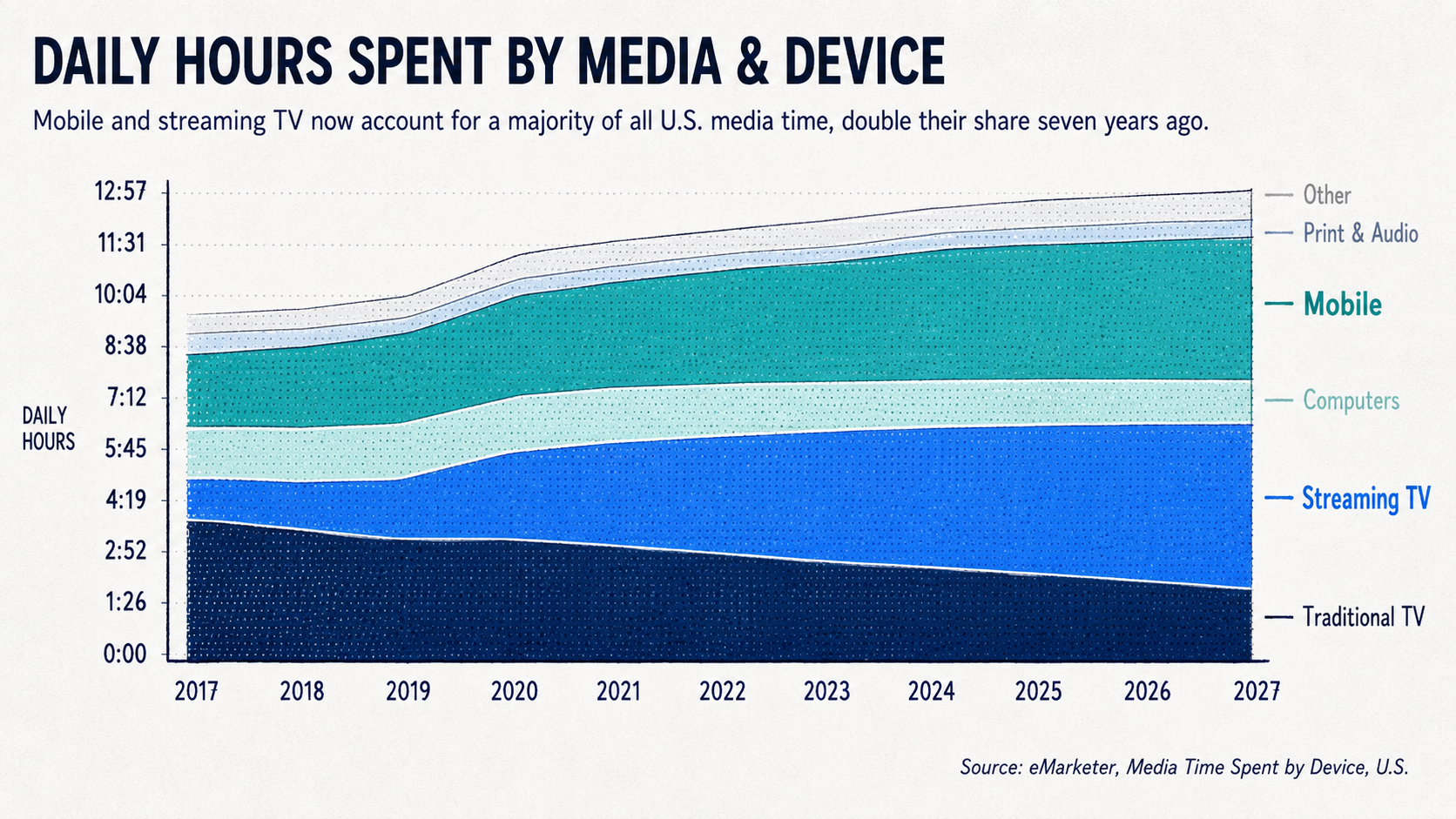
The future of video is increasingly being shaped by two screens: mobile has eaten the internet and streaming is eating television.
Together, mobile and streaming TV now account for 53% of all media time in the U.S., roughly double their share seven years ago. And despite the constant churn of new platforms, devices and formats, the basic shape of our attention hasn’t changed much lately and isn’t expected to change much in the next few years. So if you want to understand where video is going, start there: the phone in your hand and the television across the room.
Now add AI. Tools like Sora are making it possible for almost anyone to generate increasingly convincing video from a prompt. Some of it is creative. Some of it’s bizarre. Some of it looks remarkably like professionally produced entertainment. And all of it is about to get dramatically easier and cheaper to make.
Mobile feeds are the natural place for that supply to explode. They are built for frictionless creation, infinite distribution, and rapid experimentation. Which raises a more interesting question for the other major video screen: what happens to TV when our mobile feeds fill with slop?
I don’t think television simply becomes yet another feed. In fact, the opposite is likely to happen. When content becomes infinite, finding something worth watching gets harder. Familiarity becomes more useful. Curation matters more. True cultural hits become more valuable. And the distinction between “internet creator” and “television” starts to disappear.
The future of TV will be shaped across four related dimensions: creation, curation, consumption and commercialization. Or, because every framework apparently needs alliteration, the four Cs.
Creation: Familiarity becomes a feature
The first consequence of infinite creation may be that we value what we already know.
You see that instinct in what people search for on television today. As searches for Roku’s most popular series have grown dramatically, the average release year of those shows has barely moved. In 2025, 72% of series searches were for shows that premiered before 2020, and 22% were for shows that premiered before 2000. Of the 100 most-searched series, only 13 were new to the list.
For all the industry attention paid to the newest prestige drama, a lot of America still wants to watch something familiar.
That is partly nostalgia, but I think it is also a response to abundance. Familiarity takes some of the work out of choosing what to watch. A character you know carries context. A franchise has lore. A show you have watched before comes with a reliable expectation of what you are about to get.
AI makes that dynamic more interesting. As synthetic characters, influencers and entertainment become more common, established intellectual property may feel relatively more real, not less. The history itself becomes part of the product.
In an age when almost anything can be generated, familiarity becomes a feature.
What it means: The value of trusted stories, characters (including brand mascots) and franchises should rise as the supply of content expands. New ideas will still break through, but familiarity can increasingly function as a shortcut for trust.
Curation: The interface becomes the editor
If creation becomes nearly limitless, the next problem is obvious: how do we choose?
The first era of streaming was organized around apps. Pick a service, go inside, then find something to watch. But viewers increasingly don’t behave like tidy collections of subscribers. Roku households alone represent 10.2 million unique combinations of apps installed. Add genres, interests, creators, moods and moments, and there is almost no such thing as a typical streaming household.
There isn’t even one version of me as a viewer. There’s the version looking for a Knicks game, the one sitting down with my kids, the one with 25 minutes before bed and the one deciding, for no specific reason, that tonight is the night to watch Heat again.
We all have multiple TV selves.
That makes guidance increasingly important. On Roku, viewing that begins through machine-learning-driven recommendations has grown 433% year over year, compared with just 8% growth from viewers entering an app directly. Nearly a third of streaming hours now begin outside the traditional channel-entry experience, through things like recommendations, search, and personalized destinations.
That is a meaningful shift, that moves TV from the golden age of TV to the guided age of TV. The television interface is no longer simply a directory of apps. It is becoming part of the decision itself. AI will only make that role more important. An infinite shelf sounds wonderful until you have to stand in front of it. The more our preferences fragment, the more valuable the layer that can understand context and narrow the choices becomes.
What it means: The next phase of the streaming wars moves from who has the most content to who provides the best guidance. For marketers, it also means demographics and dayparts tell an increasingly incomplete story. The interesting opportunities may live in specific interests, microgenres and moments that only a personalized TV experience can identify.
Consumption: A hit becomes an ecosystem
More content should theoretically make cultural hits harder to create. That may be true. But when something does break through, the shape of the hit is changing too.
Consider Tiger King. Its arrival during the early days of COVID felt like one of streaming’s first great monocultural moments. Searches on Roku peaked about a week after release and then fell quickly. Within roughly a month, much of the moment had passed.
Now compare that with KPop Demon Hunters. Rather than peaking immediately and fading, interest built over weeks, eventually reaching its high point nearly two months after release. The movie became Netflix’s biggest film, but the film was only one part of what was happening around it. Its music climbed Spotify. Its characters became Halloween costumes. HUNTR/X appeared on Saturday Night Live. The film returned to theaters.
Each extension gave people another way into the story and another reason to come back. The idea itself isn’t new. Walt Disney famously mapped his company as a system in which movies, television, merchandise, music and parks reinforced one another. What is new is how accessible that playbook is becoming.
As the cost of making another piece of content falls, creators, fans and brands can surround a cultural moment with memes, remixes, clips, extensions and entirely new expressions of the original idea. Most will disappear immediately. Some will extend the life of the hit.
So abundance creates a paradox: monocultural moments may become harder to achieve, but the moments that do break through can sustain for longer and spread much further.
What it means: Stop thinking of a hit as a release and start thinking of it as an ecosystem. When culture gives you a moment, there are more ways to participate in it and more ways for the media itself to become part of the marketing.
Commercialization: Creators move upscreen
The fourth shift is already visible in who gets to make television.
Since the rise of YouTube and social media, successful creators have tried to cross into traditional entertainment. Now many of them no longer need to “graduate” to TV at all. They are simply bringing their audiences with them.
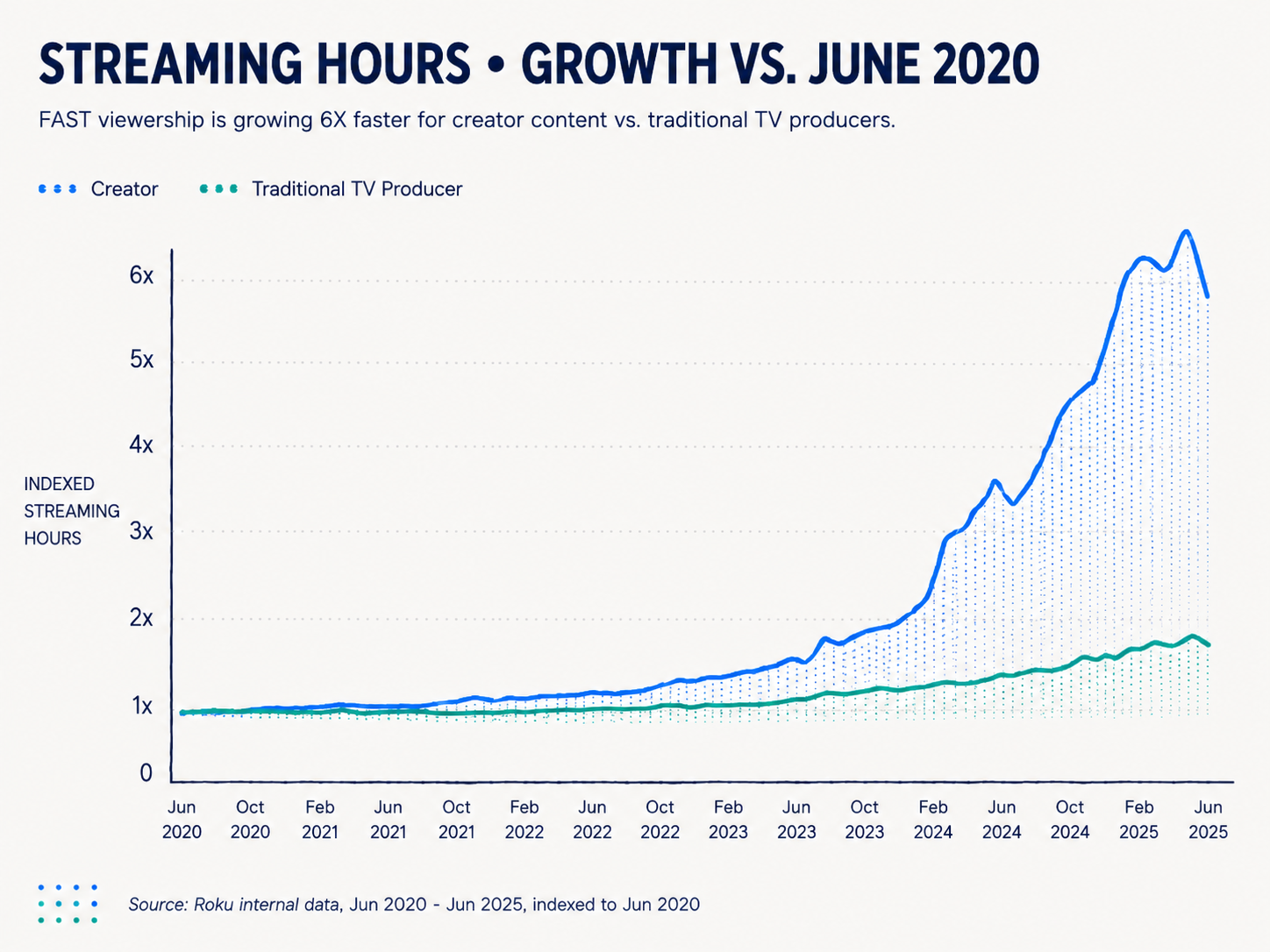
Creator programming represents a small portion of The Roku Channel’s FAST viewership, but those hours have been growing nearly six times faster than programming from traditional TV producers. Creators such as Ms. Rachel and Like Nastya, neither of whom emerged from the traditional television system, have also appeared among Roku’s 100 most-searched series for four consecutive months.
The dividing line is getting difficult to defend. If millions of people choose to watch something on a television, it is television.
AI could accelerate this migration. As social feeds become increasingly saturated with inexpensive synthetic media, established human creators have more reason to seek the context, economics and premium adjacency that television can provide. At the same time, streaming gives them a way to bring not just their programming but their business models onto the largest screen in the house.
That matters because creators have already blurred the lines between content, advertising and commerce on mobile. There is little reason to expect them to redraw those lines when they move upscreen.
What it means: Brands should think beyond sponsoring creator content on social platforms. The opportunity is to help creators move upscreen, build new formats around them and participate in the larger content-and-commerce ecosystems they bring with them.
And then TV gets reinvented too
So far, this is mostly a story about how television responds to social media overrun by a spate of AI-generated media. But television won’t only react to these technologies. It will absorb them. Today, watching TV still assumes the thing you want already exists. You open apps, browse rows, search titles and spend several minutes trying to locate it.
What happens when you can describe it instead?
I’ve been unsuccessfully trying to convince my kids to watch the Star Wars movies I loved growing up. Imagine skipping the sales pitch and simply asking the television to put me in a lightsaber battle in the style of KPop Demon Hunters. A few tweaks — more action, different ending, sharper dialogue — and it’s done.
Today, the result is mostly a novelty, somewhere between JibJab and a very sophisticated Vine. But the underlying behavior is more important than the current quality.
Search becomes a prompt. Recommendation becomes creation. The television experience becomes iterative.
That doesn’t mean people will suddenly want to manufacture every show themselves. Most of the time, I suspect we’ll still want talented people to tell us great stories. Technology makes things possible, but people decide what is actually worthwhile.
Still, it is hard to imagine generative video not becoming part of how entertainment is created, discovered and experienced. Netflix is already talking openly about using these tools. Companies such as Fable are experimenting with generated, television-length entertainment. The technology will improve quickly. The endless streaming shelf starts to look less like a shelf at all.
It starts to look like a conversation.
Preparing for the Guided Age
If that is where TV is heading, I think there are five relatively simple implications for anyone creating, distributing or marketing around it:
Be the signal in the slop. As synthetic media proliferates, human stories, trusted IP and recognizable voices become more useful ways to earn attention.
Guide, don’t overwhelm. More choice increases the value of curation. Help people navigate rather than simply adding another option to the menu.
Bring creators upscreen. Creator culture is moving onto television. Build formats, partnerships and business models that help the best talent make the jump.
Be native to the moment. The best marketing should feel like part of the experience around a cultural moment, not an interruption dropped into it.
Prepare for promptable TV. Start experimenting with interactive, personalized and shoppable experiences now. The viewer may eventually help shape not just what they watch, but the thing being watched.
The last decade of streaming was largely about giving people more. More shows. More services. More choice. AI will give us vastly more still. Which is why the next era of television may be defined by a different job entirely: helping people decide what matters.
That is the Guided Age of TV.
